Keep your pool warm and your electric bill low.
Get Started Today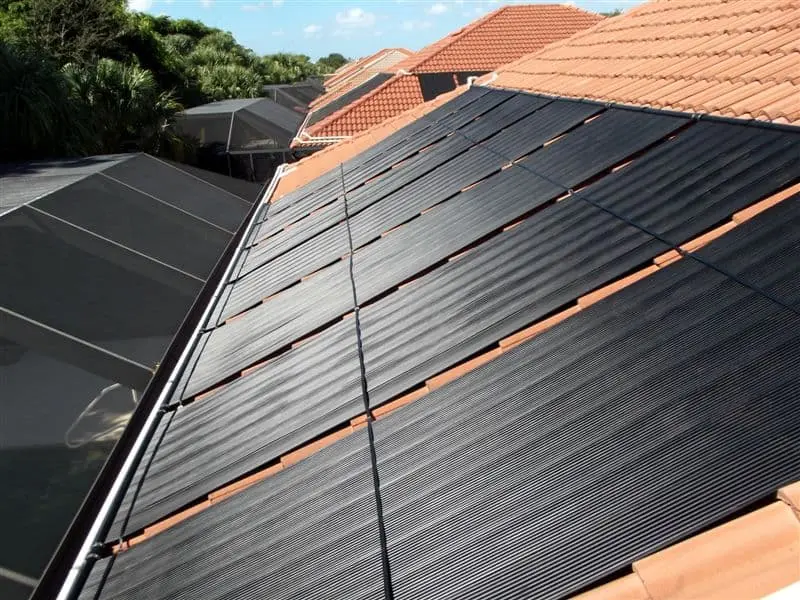
Solar pool heating is one of the most cost effective uses of solar energy
Most pools get very chilly in the winter months, even in the Sunshine State. Heating them up during this season is what we do best. Heating a pool with solar panels requires almost no electricity and makes a big difference, often raising the temperature 10 degrees or more. Solar Pool Heaters have many major advantages compared to gas, electric and even the most efficient heat pump. They could save you hundreds of dollars year after year.
Solar energy is a clean and renewable source of power, and by utilizing it to heat your pool, you reduce your carbon footprint. Solar pool heaters produce zero greenhouse gas emissions and contribute to a healthier environment.
Your swim season will triple when you take full advantage the efficiency of solar pool heat. It’s a cost-effective way to heat your pool in the cooler months.
Solar pool heat has improved over the years. Solar pool heater systems are now made out of plastic or polypropylene. By using these new materials, we can ensure a more consistent heating throughout your solar pool heating system.
We are committed to not just delivering a product but providing a comprehensive pool heating solution that offers peace of mind and long-term satisfaction. Our dedication to quality and service extends beyond installation, with ongoing support to ensure your investment continues to perform efficiently year after year. See how our maintenance program can keep your solar pool heat system in top shape for many years.
Leaking collectors, or a pool that will not warm up? See solar pool heater repair in Central Florida.
Your pool pump pushes water up to collector panels on the roof. The sun warms the water as it moves through many small tubes in the panels, and the warmer water flows back to the pool. A controller compares the roof temperature with the pool and turns a valve so water only goes up when the roof can add heat. There is no burner and no compressor; the pool pump you already run does the moving.
The main parts are the collectors, the headers that join them, the supply and return plumbing, the solar valve and actuator, the controller and its sensors, and your existing pump and filter. For the full explanation, see how solar pool heating works in Florida.
Most Florida pool heating systems use roof mounted collectors. The roof is usually the largest sunny surface on the property, it is close to the pool equipment, and it keeps the panels out of the yard. Pool collectors are typically unglazed, which means dark, durable plastic with no glass cover, strapped to the roof and plumbed into your pool line.
How much panel area you need depends mostly on the surface area of the pool, the direction and pitch of the roof, and how much shade it gets. The Florida Solar Energy Center describes sizing in terms of the ratio between collector area and pool surface area. Where the roof does not work, a ground or rack mount can be an option on some properties.
Roof mounted collectors do bring a few things to plan for. The mounts, straps and roof penetrations need to be checked over time, and the whole system has to come off when the roof is replaced. We handle removal and reinstall for a reroof and check each panel while it is on the ground.
Yes, and Florida is one of the better places to use one. They extend the swim season with heat that costs nothing, and the running cost is mostly the pool pump you already own. They also have real limits: they heat gradually, they depend on sunshine, and the plastic parts wear over the years. A pool cover helps a lot. The Florida Solar Energy Center found that a cover retains more than two thirds of the heat needed to keep a pool at a comfortable swimming temperature.
The most common reason a Florida pool solar system stops working is not the technology. It is a small problem, often a leak, with no installer left to fix it. Read the honest pros and cons in do solar pool heaters work in Florida.
There are three common ways to heat a pool in Florida, and each one solves a different problem.
Solar pool heating uses roof collectors and the pump you already run. The heat itself costs nothing, so the running cost is mostly pump time. It heats gradually and only when the sun is out.
A heat pump pulls heat from the outside air using electricity. It can hold a set temperature on cloudy days, but it adds to your power bill every hour it runs, and it works harder as the air gets colder.
A gas heater burns natural gas or propane. It heats the fastest and does not depend on the weather, which is why it often suits a spa, but it usually costs the most per degree.
Many Florida pools do well with solar as the main heat and a heat pump or gas heater as backup for the coldest stretches. We can look at your roof, your pool and your equipment and tell you honestly whether solar alone will get you where you want to be.
Most Florida roofs can carry pool collectors. What matters most is direction, pitch and shade. South and west facing roof planes usually do the most work, and a shaded roof does less. Collectors go on shingle and tile roofs, and each roof type is mounted and sealed differently. Where the roof does not suit, a ground or rack mount can be an option on some properties. We check all of this on the free visit.
Pool solar is sized to the surface area of the pool, not the gallons. Measure the length and width at the longest and widest points and multiply them. The collector area is then matched to that surface and adjusted for roof direction and shade. Panels come in 4 by 8, 4 by 10 and 4 by 12 foot sizes, so the layout can fit your roof planes. The Florida Solar Energy Center describes sizing as a ratio of collector area to pool surface area. For a worked example, see what it costs to install a solar pool heater.
A lot of solar pool heating in Florida ends up abandoned. A panel starts leaking, the company that installed it is gone or will not come out, and the homeowner closes the valve. Years later the panels are still on the roof doing nothing.
AllSolar Energy takes those systems over and repairs them, whatever the brand and whoever installed them. That usually starts with leak repair or an annual inspection, and sometimes means replacing worn panels. If your installer is out of business, see abandoned solar pool heater takeover.
We repair, replace, and remove and reinstall solar pool panels from every brand, including Heliocol, SunValue, Universal, SunStar, Aquatherm, Hi-Tech, Solar Industries, FAFCO and Techno-Solis panels, plus black polymer tile systems. It does not matter who installed yours or whether that company is still around. Heliocol owners can see Heliocol solar pool heater repair.
Pool collectors wear differently from solar electric panels. They heat and cool every day while carrying chlorinated water in full sun, so leaks and eventual panel replacement are part of owning one. In our experience, components or the whole system may need replacing after one or two decades, depending heavily on installation and care. See how long solar pool panels last.
The heat itself is free. What you pay for is mostly pump run time, plus upkeep. A variable speed pump, a clean filter, sensible controller settings and a pool cover all keep that low. See what a solar pool heater costs to run, and for the price of a new system, what it costs to install a solar pool heater.
Yes. We repair solar pool heating from any brand and any installer, including companies that are out of business.
Leaks at the panels, the header joints between panels and the roof plumbing. Many of those are ordinary repairs.
Most Florida systems use roof mounted collectors, because the roof is usually the largest sunny surface near the pool equipment. Some properties can use a ground or rack mount instead.
It helps on sunny days and extends the swim season into the cooler months. It adds less heat on cloudy days and none at night, so a pool cover and sometimes a backup heater help on the coldest stretches.
Most systems use the existing pool pump. Whether yours is a good match depends on the size of the system and the roof height, which we check during a visit.
Yes. The panels sit on the roof deck, so they are removed before the reroof and reinstalled afterward. We do that work.
Usually, because the heat is free and the pump is already running, while a heat pump uses electricity for every degree. How much you save depends on your pool, your roof and how warm you want the water.
Yes. Many owners keep it as backup for the coldest days and let solar do most of the work.
A pool cover holds heat in and panels add heat, so the two work well together. The Florida Solar Energy Center found that a cover retains more than two thirds of the heat needed to keep a pool comfortable.
Yes. We work in Orlando, Sanford and the rest of our 17 counties. See the city list below.
Collectors, controller, automatic valve, photographs, documents and every service visit, kept together against your property instead of remembered. Free, and you can add to it over time.
Free to read first, no account needed: how solar pool heating actually works, what to expect through the Florida year, and how to spot a collector leak from the ground. SunTroller is a temperature monitor we are developing for supported pool heating systems. It is not yet available.
Most of the pool heating work we do is on systems that already exist: leaking panels, systems shut off after a leak, and systems whose installer is gone. Start with the page that fits your situation.
Local pages for the cities where we do the most pool work:
AllSolar Energy has licensed local crews in 17 Florida counties. Find yours for local service details: