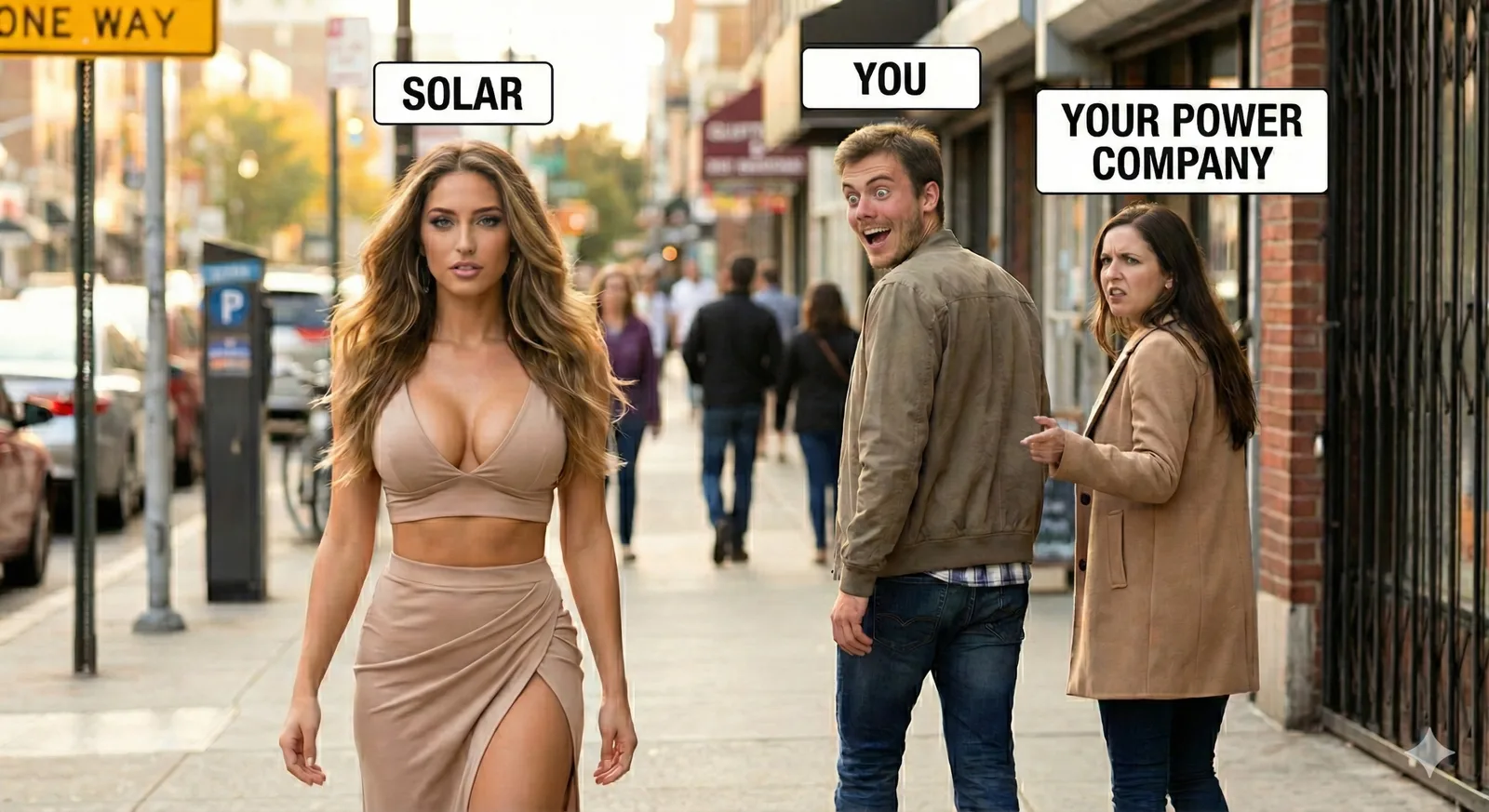
They must, right? They are losing all that revenue, after all. Solar is their fastest growing competitor. If everyone went solar, how would the power companies stay in business?
The reality is that power companies don’t mind at all. As a matter of fact, some power companies used to offer incentives to their customers for going solar. Some still might.
It doesn’t make sense, does it? Publix does not recommend Winn-Dixie. Ford doesn’t admit that Toyota is better. Coke and Pepsi? Fughetaboutit!
Why would a power company, which makes its money by selling electricity, encourage its customers to get their electricity elsewhere? If the average electric bill in Florida is $164/month and a thousand people switch to solar electricity, that costs the power company $164,000/month. A lot more than a thousand people have made the switch. Most companies could not survive long if they lost $164,000/month in revenue. Power companies can, and do, with losses even greater than that.
If Google’s AI can be believed, somewhere between 253,000 and 275,000 Florida residences have had solar panel installations. Let’s take the high number and multiply that by the $164 average power bill. That’s $45,100,000/month in lost revenue every month. How are the shareholders not running for the hills? How are these power companies still showing record profits?
Let’s not pretend that this post will be able to answer these questions completely. There is a lot of big-business voodoo being cast by big-business wizards that we will never understand. We like to keep it simple over here. Let’s just talk supply and demand.
Over one thousand people move to Florida every day. That’s a net figure, meaning it’s over a thousand after you subtract the number that moved out from the number that moved in. 365,000 new Floridians a year and they all have at least the one thing in common: they all want electricity. How do you think that affects supply and demand?
The supply gets more scarce. You’ve heard of rolling brown outs and black outs in other parts of the country. The predictiest predictors are predicting similar problems in Florida soon. In addition to all the other challenges Florida presents to power companies, weather, wildlife, aging infrastructure – the burgeoning population is not something they will be able to keep up with forever. Especially not at over a thousand a day.
A thousand a day is about thirty thousand a month. Want to guess how many people in Florida go solar every month? That’s right! About twenty-five hundred. That means the power companies are netting about twenty-seven thousand five hundred new customers every month. That is good cheese! We would love that! Or would we?
We could barely handle the rush at the end of year of customers demanding we get their new solar systems in by December 31st so they could get their tax credit. We are little guys. We would drop the ball repeatedly if we tried to make an extra twenty-seven thousand people happy every month. Guess what? On a much larger scale and a much longer timeline, the power companies are in the same boat.
The amount of electricity our power companies can create is a finite number. Dropping the ball is not a matter of if, it’s a matter of when. Because of this increase in demand, the supply is going to get scarce, and the price of electricity will go up. It will go up a lot more than the historical 5%/year we have been conditioned to accept.
Raising prices and encouraging as many Floridians as possible to go solar is just kicking the can down the road. To compound the problem, AI data centers will require as much electricity as a hundred thousand households. Where is that going to come from? For now, we are okay. Power is pretty reliable in Florida, but we are running out of runway.
We don’t pretend to know what the ultimate solution is for Florida and the power companies. We do know the solution for individual households. Solar that creates about 125-150% of what the household consumes plus batteries. 100% to keep the house running all day, 25-50% to recharge the batteries which keep the house powered up all night.
This set up takes you out of the equation and the future problems it adds up to. It gives you energy independence and security in an uncertain energy future. Also, typically it costs a lot less than what you are going to pay for electricity anyway. If you won’t do it for the financial benefits, think of the power companies! They are in for a rough decade or so. Anything you can do to lighten their load would be much appreciated.
PrevPreviousWhat if your power bill doubled?
NextSolar Leases and Artificial Intelligence, and why both are dumb.Next
A free Solar Home account keeps your panels, inverter, batteries, pool heater or water heater on record: models, serial numbers, photographs of the labels, warranties, utility and interconnection documents, and every AllSolar service visit attached to your property.
Free to read first, no account needed: the Solar Home guides explain how to identify your equipment, what your production figures mean and what the common warnings are telling you.