We are getting a lot of calls from people who thought they owned solar panels asking for service on their solar electric systems because the company they thought they bought it from is either not answering their customers’ calls, have gone out of business, or both. We try to help, but after some initial research, we find out that these homeowners do not own their solar, they are still renting their electricity. All they did was change who they write the check to.
Solar leases are designed to sound alluring up front and downplay what happens down the road. Their target market are people who trust the salesperson to be the subject matter expert on their behalf and there seem to be a lot of those people. They do not know the right questions to ask, naturally, because they are not in the industry. Unfortunately, we don’t live in a world where salespeople can be trusted that way. Few are truly subject matter experts, and less do anything on their customers’ behalf.
If solar leases are presented honestly, they make no sense and no one would agree to one. Here’s the con, in a nutshell. They, the sales organization, propose the homeowner let them put a third party’s, the leasing company’s, panels on the customer’s roof. In exchange for the roof real estate to place the leasing company’s power plant, the homeowner will have a static and reduced power bill … initially.
If it is presented honestly, and that is a big and rare if, they also explain that while their electricity bill will go down initially, there is often an escalator, and it can go up every year, just like the power company’s rates, but at a smaller percentage.
Also, if presented honestly, they make it clear to the homeowner that they do not own the equipment, and as such, they will not be allowed to choose who works on it. Many solar lease salespeople shorten that explanation to calling the solar “maintenance free.”
What is rarely mentioned is what happens and who is responsible if the homeowner wants to replace their roof. Who pays to take all those panels down, store them, then put them back up after the roof is finished? Many times, it is the homeowner who is faced with that unexpected expense. Well, the leasing company can insist the homeowner use only the leasing company’s solar contractor for that. They can charge pretty much whatever they want. That is just one example where the homeowner doesn't have normal competitive-shopping leverage.
Finally, what is hardly ever brought up, is what if the homeowner chooses to sell their home? Well, that deal just got complicated because their house has a third party’s property attached to the top of it. Who makes the remaining lease payments? If the buyer chooses not to, who takes the panels away? How does this affect the price? What realtor or buyer wants to deal with the hassle?
Where’s the benefit to the homeowner? The initial lowered power bill? Ten to fifteen dollars a month? The smaller rate increase percentage? Also not all that seductive if you own a calculator. Down the road, the homeowner is in the same lose-lose predicament they are in with their power company. They can’t take their business to a competitor and the rates may still increase every year. They are typically locked in for twenty to twenty-five years.
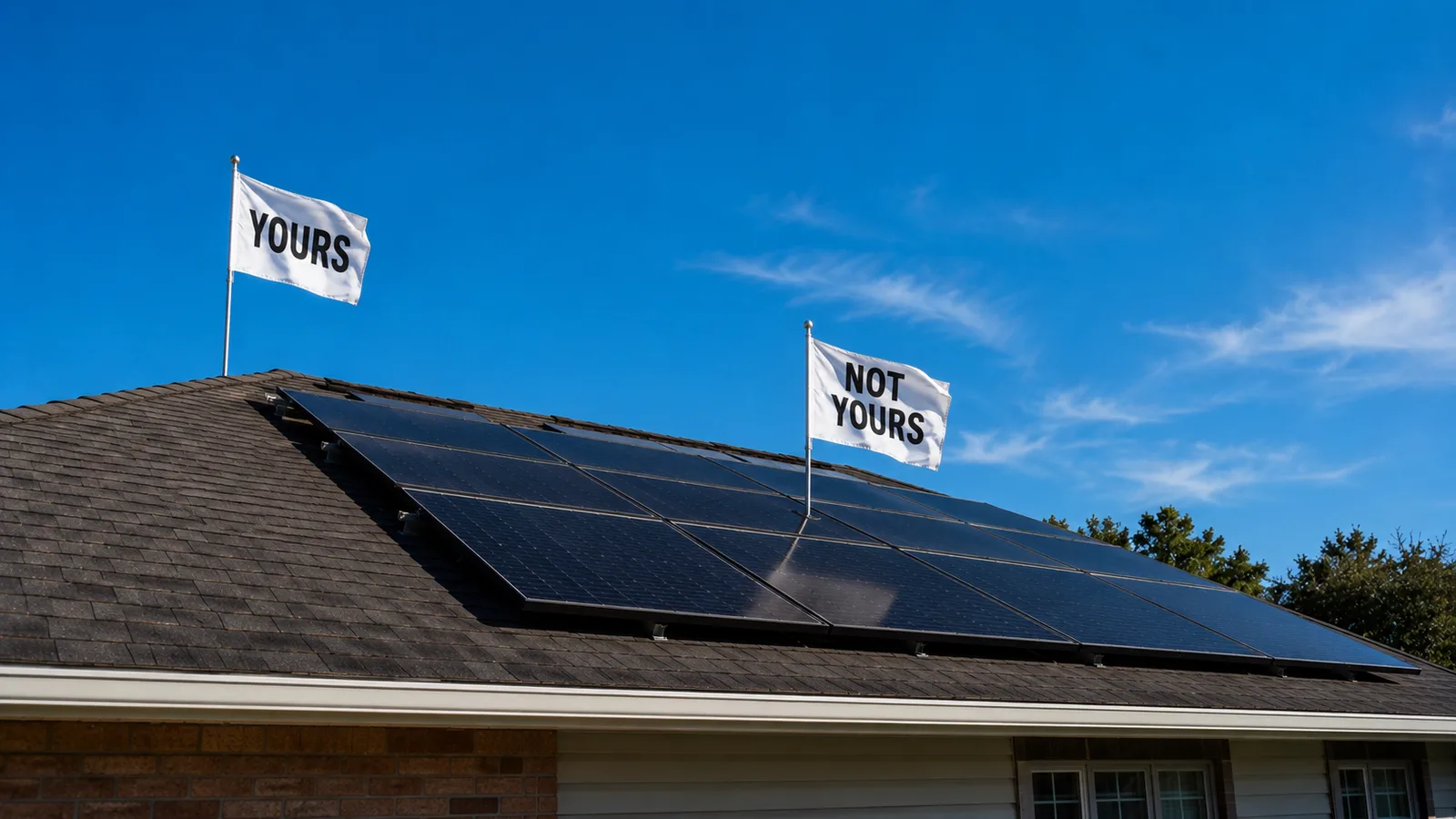
The benefit a solar lease salesperson likes to repeat, a lot, is that there is no “upfront cost.” They say it like that feature alone makes leasing solar a no-brainer. They point at the payment being lower than your current average electric bill, tell you that your payment stays the same every month, and tell you there is no upfront cost as if these things are unique to leases or Power Purchase Agreements. They aren’t.
With fair to good credit, you can finance a solar system with a traditional solar loan and get all those same benefits, plus owning your equipment, choosing any contractor to work on it, and never having your solar payment increase. Many times, the payment on these loans is about the same as you are paying for electricity anyway. At the end of the term, most panels will continue functioning for years, and now you have little to no electric expense.
Here are the tactics to use as a salesperson if you want someone to sign a lease agreement: say the new lower power bill with your whole chest, then mumble through the rest of the details. Use industry terms, quickly, in a tone that implies everyone knows what they mean. If the customer asks a question you don’t want to answer, ask them to show you where in the garage they want to put the inverter like it is relevant to their query and remind them that there is no upfront cost.
For many years, if you wanted to be a real scumbag salesperson, you would raise the total price of the system thirty-five percent then take thirty percent off and then show the homeowner how you reduced it by thirty percent because the leasing company will get the tax credit and pass the savings along to their customer. Pocket the extra five percent for being so clever. That lie is only a bit better than letting the homeowner think they are getting the tax credit. Many homeowners who leased solar expecting the tax credit didn’t find out they were not eligible until their tax professional shrugged.
BTW – That is an old tactic that should not work on anyone today. The federal Residential Clean Energy Credit for homeowners ended for systems placed in service after December 31, 2025. The tax rules governing third-party-owned systems have also changed.
The worst kind of salesperson is the one who lets the homeowner sign a lease thinking they are buying, not leasing. There are a bunch of people that happened to. Now, when they need service and their installation contractor, the sales organization, the leasing company, or all three are out of business, or otherwise not answering calls, what do they do?
Florida law has required a separate disclosure telling lease customers, in plain language, that they are leasing and do not own the system since 2017. The fact that we still encounter homeowners who don't understand that distinction tells you how badly the sales conversation can go.
There are homeowners out there, right now, who are having a monthly lease payment drafted out of their bank accounts to pay a lease on equipment that no longer functions while also paying for electricity from their power company. They have no one to call and fix the equipment, and if they do reach us, we have nothing but bad news for them because, since the equipment belongs to a third party, the homeowner cannot necessarily authorize us to repair or modify it. Without authorization from the actual system owner, our hands are tied.
These are problems that were unimaginable at the time they signed that contract. It’s too complicated a mess to anticipate. We hate it for them but there’s not much we can do for them until they own their solar.
If you, or anyone you know, is in a solar lease there are many law firms who have taken up the call. Law firms are now representing homeowners in disputes involving these agreements. If an agreement is successfully resolved and the homeowner ultimately obtains ownership of the equipment, that's when companies like ours can step in and help with the solar itself.
We recommend Covar Law Group. (800) 551-4181
A free Solar Home account keeps your panels, inverter, batteries, pool heater or water heater on record: models, serial numbers, photographs of the labels, warranties, utility and interconnection documents, and every AllSolar service visit attached to your property.
Free to read first, no account needed: the Solar Home guides explain how to identify your equipment, what your production figures mean and what the common warnings are telling you.